 September 9, 2026
Someone with an uncomfortable thumb usually starts by searching for a thumb support, and the results look interchangeable. Fabric wraps, rigid splints, neoprene sleeves, things with metal stays, things that cover the wrist, things that do not. Prices vary enormously and the descriptions all sound broadly similar.
They are not interchangeable, and the differences are not subtle once you know what to look at. The useful question is not which support is best, but which joint a given support is holding and which joints it leaves free, because that single distinction determines whether it can be worn while you actually do things.
The Thumb Has More Than One Joint
Start here, because it explains most of the category.
The thumb has three joints worth naming. At the very base, where the thumb meets the wrist area, sits the carpometacarpal or CMC joint, often called the basal joint. In the middle, at the web of the hand, sits the metacarpophalangeal or MP joint. At the tip sits the interphalangeal joint.
Different conditions involve different joints. Discomfort at the base during pinching points to one area; an injury from a fall while holding a ski pole classically involves the MP joint and its ligaments. These are different problems in different places, and support that stabilises one does not necessarily do anything useful for the other.
So the first question about any thumb support is a simple one: which joint does this hold?
What Each Type Covers
Broadly, the category divides by how much of the hand and wrist the support encloses.
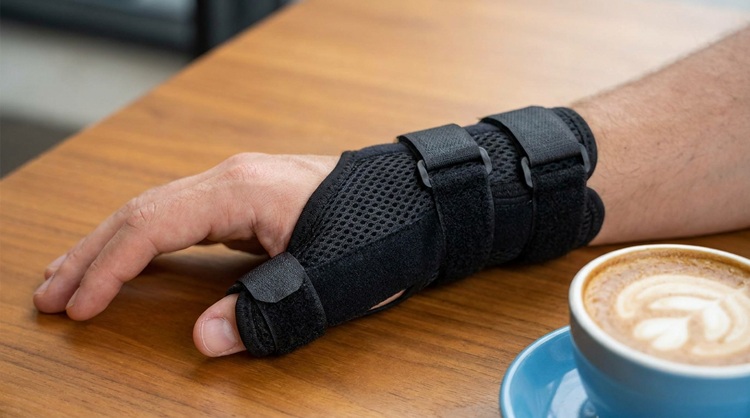
- Wrist and thumb splints extend up the forearm and immobilise both the wrist and the thumb. They hold a great deal still, which is appropriate in some clinical situations and after some surgery, and they substantially limit hand use while worn.
- Hand-based thumb supports sit on the hand without crossing the wrist. They stabilise thumb joints while leaving the wrist free to move, which preserves a considerable amount of function.
- Supports targeting the base of the thumb stabilise the CMC joint specifically while leaving the thumb tip, the finger joints, and the wrist free. This is the narrowest and most functional approach.
- Supports targeting the MP joint stabilise the middle thumb joint, which is the relevant area for certain injuries rather than for base-of-thumb arthritis.
- Soft sleeves and wraps provide compression and a sense of containment without rigid stabilisation. Some people find them comfortable; they are doing something different from a support with a rigid element.
Immobilising and Stabilising Are Different Goals
These two words get used loosely and they describe genuinely different intentions.
Immobilising means preventing motion, and there are situations where that is exactly what a clinician wants: after certain injuries, following some operations, or during a period of rest for an irritated structure. It is generally a temporary arrangement with a defined purpose and a defined end.
Stabilising means supporting a joint so it stays aligned while it moves and while it takes load. The joint continues working; it does so with help. This is the approach that suits long-term conditions where the aim is to keep doing things rather than to stop doing them for a period.
Confusing the two leads to a common and frustrating outcome: someone with a long-term joint issue buys a rigid immobilising splint, finds they cannot use their hand while wearing it, wears it only in the evening when they are not doing anything demanding, and concludes that supports do not help. The support was doing its job. It was the wrong job.
Materials and Construction
A few practical differences worth noticing on any product page.
The rigid element, where there is one, may be plastic, thermoplastic, or metal. Some are fixed in shape and some can be contoured to an individual hand, which affects how closely the support matches a specific anatomy.
Bulk determines what you can do while wearing it. A support that fits under a glove opens up work and outdoor activity that a bulky one does not.
Washability matters more than people expect, because a support worn for hours daily against skin needs cleaning. Some can be machine washed; some cannot.
Latex content is worth checking on any product worn against skin for extended periods, particularly for anyone with a known sensitivity. Manufacturers who publish this state it clearly; the Push MetaGrip, for instance, is published as latex-free.
Sizing is the variable that most often determines whether a support works. A support that is too large will not stabilise, and one that is too small will be uncomfortable enough that it does not get worn. Manufacturers who offer a range of sizes and an exchange arrangement recognise that a chart is a starting point rather than an answer.
Getting the Choice Right
The reliable route is a clinical one. A hand therapist or physician can identify which joint is involved, which is the piece of information the entire decision rests on, and can often try options on a hand rather than reasoning from a photograph.
Buying without that step is common and workable for straightforward situations, provided the buyer knows which joint they are addressing and reads the product information properly rather than the headline.
When comparing options, a thumb brace from BraceLab sits within a catalogue that includes supports targeting the base of the thumb and the MP joint separately, alongside wrist and other supports. BraceLab is the exclusive U.S. distributor of Push and Push Sports braces and was founded by Judy C. Colditz, OT/L, CHT, FAOTA, a hand therapist and past president of the American Society of Hand Therapists. Whichever brand a person considers, the specification to check is which joint is stabilised and which joints remain free.
Key Takeaways
- The thumb has three joints and different supports address different ones; identify the joint before choosing.
- Wrist and thumb splints immobilise a great deal and limit hand use while worn.
- Hand-based supports leave the wrist free; base-of-thumb supports leave the most function available.
- Immobilising and stabilising are different goals, and mismatching them is a common source of frustration.
- Bulk, washability, and whether a support fits under a glove all determine when it can realistically be worn.
- Latex content is published by manufacturers who state it and is worth checking for anyone with a sensitivity.
- Sizing decides whether a support works at all, so exchange arrangements are practically useful.
Frequently Asked Questions
How do I know which joint is involved?
By where the discomfort sits and what provokes it, confirmed by examination. Discomfort at the very base during pinching and twisting points to a different area than discomfort at the web of the hand after a fall. Because the areas are close together and the distinction matters for what helps, a clinician is the reliable source rather than self-assessment.
Can I wear a thumb support all day?
It depends on the support and the situation, and it is a question for the clinician guiding your care. Supports that leave function available are generally intended for use during activity, while immobilising splints usually come with specific guidance on wearing time. Following the guidance given for your particular circumstances matters more than any general rule.
Is a more rigid support better?
Not automatically. Rigidity provides more restriction, which is valuable when restriction is the aim and counterproductive when it prevents someone from doing the things they wanted the support for. The right amount of support is the amount that matches the situation.
Do soft neoprene wraps do anything?
They provide compression, warmth, and proprioceptive feedback, which some people find comfortable. What they do not provide is rigid stabilisation of a specific joint. Whether that is sufficient depends entirely on what someone needs, and it is worth being clear about which of the two you are buying.
Should the support cover my wrist?
Only if the wrist itself needs support or a clinician has advised it. Crossing the wrist removes wrist motion, which is a considerable functional cost to accept if the wrist is not the issue. Many people find a support that leaves the wrist free considerably easier to wear during ordinary activity.
What if the support does not fit properly?
Then it is unlikely to do what it is meant to do, and it should not simply be endured. Sizing charts are guidelines and hands vary, so trying a different size is often the answer. Suppliers offering exchange arrangements for fit exist precisely because this is common.
Conclusion
The thumb support aisle looks confusing because it contains products doing several different jobs under one broad label. Once the question becomes which joint is being stabilised and which joints stay free, the options separate quickly and the choice starts to make sense. Identifying the joint is the step worth taking properly, and it is the one a clinician can settle in minutes.