 October 5, 2026
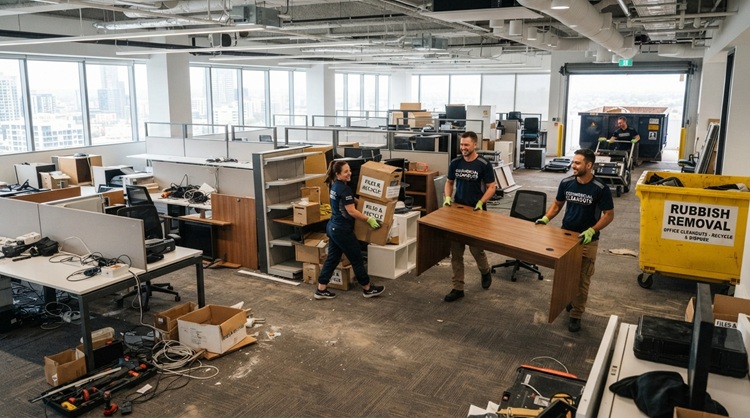
A commercial cleanout is a different animal from a residential one. The volume is larger, the items are heavier and more uniform, and the timing is constrained by a lease end, a move date, a renovation schedule, or the simple fact that the business has to keep operating while the clearing happens. A homeowner can take a weekend. A business often has a Friday evening and a Saturday, and whatever is not gone by Monday is a problem.
Commercial cleanouts go smoothly when they are planned like any other operational project: scope defined, assets and data handled first, a schedule that works around the business, and a hauler chosen for its ability to handle the volume and the access rather than for the lowest number. This guide covers the common commercial cleanout scenarios, the sequence that keeps them on schedule, the handling of equipment and records that a residential job never raises, and what to look for in a commercial junk removal crew.
The Common Scenarios
- Office closure or relocation. Desks, chairs, filing cabinets, cubicle partitions, conference tables, and years of accumulated supplies, cleared to a deadline set by the lease.
- Retail turnover. Fixtures, shelving, displays, signage, backroom stock, and the contents of a space being handed back to a landlord or prepared for a new tenant.
- Warehouse and storage cleanout. Pallets, racking, obsolete inventory, packaging, and equipment that has sat for years because no one had time to deal with it.
- Renovation debris. Demolished finishes, old fixtures, flooring, and construction waste from a build-out, often on a contractor’s timeline.
- Property management cleanups. Abandoned tenant property, common-area junk, and the periodic clearing of storage rooms and loading areas.
- Bulk and recurring pickups. Businesses that generate regular volumes of discarded material and need a scheduled haul rather than a one-time cleanout.
Scope First: What Stays, What Goes, What Gets Sold
The single biggest cause of commercial cleanout delays is a crew arriving to find that no one has decided what is actually leaving. In an office, the answer is rarely “everything.” Some furniture goes to the new location, some equipment is being sold, some records must be retained, and some items belong to employees. A walk-through with a decision-maker, tagging items by destination, has to happen before anyone is scheduled.
Four destinations cover most commercial items:
- Moving with the business. Tagged and left alone, or staged separately for the movers.
- Sold or returned. Office furniture in good condition has a resale market; leased equipment goes back to the lessor; some fixtures are sold to the incoming tenant. These items need their own handling and timeline.
- Donated. Usable desks, chairs, shelving, and supplies are welcomed by schools, nonprofits, and community organizations. A hauler that sorts for donation can route these.
- Disposed. Everything else, which is usually the majority by volume.
Data, Equipment, and Records
This is where commercial cleanouts diverge sharply from residential ones, and where a business can create real exposure by treating the job as simple junk removal.
Electronics and data
Computers, servers, copiers, and phones contain data. Hard drives should be removed, wiped, or destroyed by a process the business can document before the equipment leaves the premises. Copiers and multifunction printers have internal storage that most businesses forget about. A junk removal crew hauls equipment; it does not provide data destruction, and the business should not assume otherwise.
Records
Paper records subject to retention requirements, whether financial, personnel, medical, or legal, cannot simply be thrown out. The business should identify what must be kept, what can be destroyed, and what requires certified shredding rather than a dumpster. The hauler takes the boxes that have been cleared for disposal; the decision about which boxes those are belongs to the business.
Leased equipment
Leased copiers, water coolers, point-of-sale terminals, and similar equipment belong to someone else and must be returned, not hauled. A tag on each leased item before the cleanout prevents an expensive mistake.
Hazardous and regulated materials
Commercial spaces accumulate things residential ones do not: fluorescent tubes, ballasts, batteries, toner, cleaning chemicals, and in some industries far more. These require specific disposal routes and most haulers will not take them in a general load. Identify them in the walk-through and arrange their disposal separately.
Scheduling Around the Business
The cleanout should be invisible to customers and minimally disruptive to staff, which usually means off-hours.
- Evenings and weekends for offices and retail, so the crew works when the space is empty.
- Phased pickups for a business that is clearing while still operating: one department or one zone at a time, with the crew returning on a schedule.
- Coordination with movers and contractors. On a relocation, the junk crew should come after the movers have taken what is going and before the landlord’s walk-through. On a renovation, the debris haul should be timed to the contractor’s phases.
- Building logistics. Loading docks, freight elevators, and after-hours access all need to be arranged with building management in advance. A crew that arrives to find the freight elevator locked has lost an evening.
Choosing a Commercial Hauler
Commercial work asks more of a junk removal company than residential work does, and the right questions reflect that.
- Capacity. Can the company handle the volume in the time available, with enough crew and truck space to clear an office floor in an evening rather than a week?
- Insurance. Essential for any crew working in a commercial building, and building management will often require proof before granting access.
- Access experience. Loading docks, freight elevators, stairwells, and tight commercial corridors are routine for a crew that does this work and a struggle for one that does not.
- Flexible scheduling. Off-hours availability and the ability to return for phased pickups.
- Sorting and donation. Office furniture in particular has a strong donation market, and a hauler that routes it there reduces disposal weight and does something useful with it.
- Clear pricing. A quote from a walk-through or photographs, with the conditions that would change it stated in advance.
In the Southern Tier of New York, Morse Hauling & Junk Removal provides commercial junk removal services covering office cleanouts, retail and warehouse junk removal, property management cleanups, construction and renovation debris, bulk trash pickups, and electronics and supplies, with the crew removing items from inside the space or loading from a staging area, scheduling around the business’s hours where possible, and sorting usable items out of every load for donation to local organizations. The company is fully insured, quotes from photographs or an in-person visit, and serves Elmira, Horseheads, Elmira Heights, Corning, Ithaca, and nearby towns. Whatever hauler a business uses, those are the capabilities to confirm before the lease deadline arrives: volume, insurance, access, scheduling, sorting, and a quote that holds.
A Commercial Cleanout Checklist
- Walk the space with a decision-maker and tag every item by destination: moving, sold or returned, donated, disposed.
- Remove and handle data storage from all electronics, including copiers, before anything leaves.
- Identify records that must be retained or shredded, and separate them from general disposal.
- Tag leased equipment for return.
- Pull out hazardous and regulated materials and arrange their separate disposal.
- Arrange building access: dock, freight elevator, after-hours entry.
- Schedule the hauler after the movers and before the landlord’s walk-through.
- Get a quote from a walk-through or photographs, with change conditions stated.
- Stage disposal items near the loading point if staff time allows.
- Confirm the space is clear and swept before handing over the keys.
Key Takeaways
- Commercial cleanouts fail on scope, not on hauling; tag every item by destination before scheduling anyone.
- Data, records, leased equipment, and regulated materials need handling that a junk crew does not provide; the business owns those decisions.
- Schedule off-hours, phase the work if the business is still operating, and arrange building logistics in advance.
- Choose a hauler for capacity, insurance, access experience, flexible scheduling, sorting, and a quote that holds.
- Office furniture has a strong donation market; a hauler that routes it there reduces cost and waste.
Frequently Asked Questions
Can a junk removal company clear an office over a weekend?
A crew with adequate capacity can clear a typical office floor in an evening or a weekend, provided the business has tagged what is leaving, handled data and records, and arranged building access in advance.
Will a junk removal company destroy hard drives or shred documents?
Generally no. Junk removal hauls equipment and boxes that have been cleared for disposal. Data destruction and certified shredding are separate services the business should arrange before the cleanout.
What happens to office furniture after a cleanout?
At a hauler that sorts, usable desks, chairs, and shelving are donated to schools, nonprofits, and community organizations. At one that does not, they go to the landfill with everything else.
Can a business get recurring junk pickups?
Yes. Many haulers schedule regular bulk pickups for businesses that generate steady volumes of discarded material, which is often cheaper and simpler than periodic large cleanouts.
What commercial items will a hauler not take?
Fluorescent tubes, ballasts, batteries, toner, chemicals, and other regulated materials require specific disposal and are typically excluded from a general load. Identify them in advance and arrange separate handling.
Does the hauler need to coordinate with building management?
Usually, for dock access, freight elevator scheduling, after-hours entry, and proof of insurance. The business should make those arrangements before the crew’s first visit.
Conclusion
A commercial cleanout is an operations project with a hauling component, not the other way around. Define the scope, handle the data and records and leased equipment that a crew cannot, schedule around the business and the building, and choose a hauler that can move the volume through commercial access on a deadline. Done in that order, the space is clear by the lease end, nothing that should have been kept is gone, and the business never stopped running.