 September 2, 2025
Let’s be honest: B2B marketing isn’t getting any easier. Sales cycles are longer, buying committees are bigger, and content needs to do more than just grab attention—it has to educate, nurture, and persuade. That’s where AI ad generators step in.
You might think AI ads are just for B2C brands running flash sales. Not anymore. A smart AI advertisement generator often developed by AI services companies, can help you move B2B leads through the mid-funnel faster, without burning out your creative team.
This guide is for marketers juggling lead nurturing, personalization, and tight deadlines. If you’ve ever thought, “There has to be a faster way to create effective ads,” you’re in the right place.
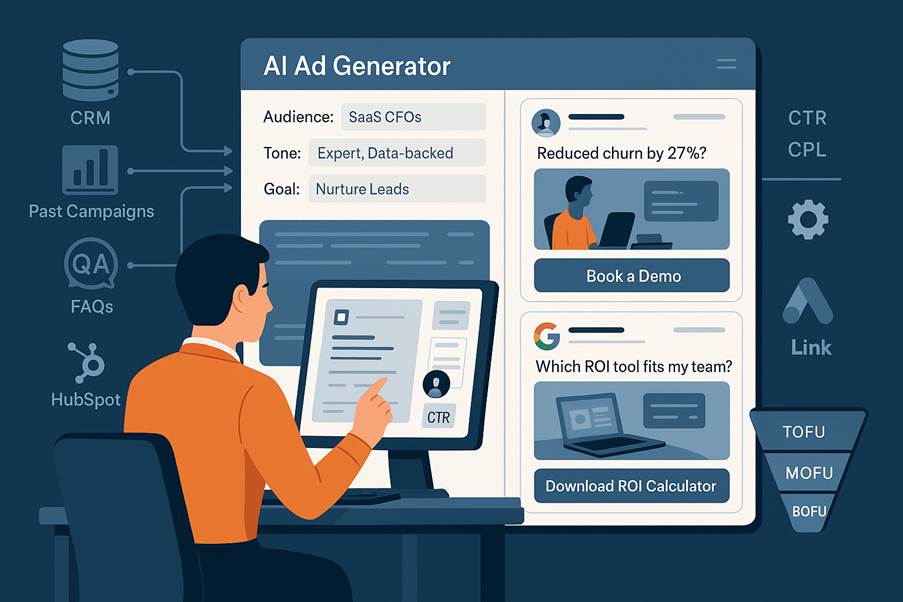
So, how do these AI ad tools actually work? They take your product info, your target audience, maybe a CTA or two, and boom—you get multiple ad variations optimized for different channels.
What to look for in an AI ad creator
- Upload your brand voice and tone: You should be able to train the AI on your company’s language—technical, casual, industry-specific—so the generated copy aligns with how you already speak to customers.
- Integrate with tools like LinkedIn Ads, HubSpot, or Google Ads: Pick a tool that lets you export ads directly into your campaign platforms. It saves time and ensures formatting consistency.
- Access to analytics dashboards: The AI should not only create ads but also track performance. Insights like CTR, impressions, and conversion assist you in tweaking future content easily.
Try this: Use a freemium AI ad maker to generate variations of your current campaigns. Compare them with human-written ones for tone, speed, and engagement.
Why B2B Ads Need a Different Strategy Than B2C
Here’s the thing about B2B buyers: they don’t buy on impulse. They research, compare, consult colleagues… and only then, maybe, they’ll click your CTA.
That’s why mid-funnel (MOFU) campaigns matter. AI ad generators help you:
- Show relevant case studies to decision-makers: Feed AI a successful use case and specify the industry (e.g., “Mid-market SaaS”). It can create testimonial ads tailored to CTOs, CFOs, or Marketing Heads.
- Promote demo offers to specific job titles: Train the AI to push CTAs like “Schedule a personalized walkthrough” to Sales Ops professionals or Product Managers, who often influence decisions.
- Highlight ROI tools for finance teams: Insert calculator URLs and prompt the AI to emphasize budget impact, savings, or ROI projections in the ad copy.
Quick tip: Use AI advertising tools to dynamically adjust messaging based on lead behavior—what content they viewed, webinars they attended, or resources downloaded.
Funnel Stages in B2B AI-Powered Campaigns
Let’s break it down:
- TOFU (Top of Funnel): AI tools help you generate interest. Let them write educational or awareness ads that promote blogs, ebooks, or thought leadership.
- MOFU (Middle of Funnel): Generate ads that speak directly to pain points. For example, highlight solutions in ad copy for abandoned demo signups or those who visited the pricing page.
- BOFU (Bottom of Funnel): The AI can create urgency-driven messaging like “Limited seats for our 1:1 onboarding session” or “See how we compare with [competitor]” to nudge conversions.
Do this now: Let your AI ad generator build three versions of your MOFU offer—each with different tones (urgent, friendly, expert). Test them across channels.
Tactical Ways to Use AI Ad Generators
MOFU content needs to show you’re a trustworthy solution. Use AI generators to:
- Address objections: Train it on sales call transcripts or common FAQs. Ask it to generate copy that addresses fears like “What if this doesn’t scale?” or “Is onboarding complex?”
- Demonstrate outcomes: Paste in metrics like “Reduced churn by 27%” and let the tool turn them into sharp ad copy tailored to decision-makers.
- Offer valuable assets: Instead of generic CTAs, let AI promote high-converting offers like a downloadable implementation checklist or a 14-day trial, depending on audience intent.
Ask the AI to generate 5 versions of a testimonial ad—each personalized for industries like Fintech, SaaS, or Manufacturing. It saves creative time without losing nuance.
Smart Channel Strategy with AI for B2B Ads
Not all platforms are equal. MOFU success depends on:
- LinkedIn Sponsored Content: AI can help write ad variations based on job title, seniority, and industry filters. For example, messaging for CMOs vs. Engineering Leads.
- Google Display for Retargeting: Let AI create remarketing banners tailored to actions like ebook downloads or product page visits.
- Industry Programmatic Placements: Use AI to adjust ad creatives by context—whitepapers on B2B forums, testimonials on SaaS review sites.
Optimization tips:
- Ask your AI ad tool to review past campaign performance and suggest better budget splits.
- Let it generate variations of underperforming ads using new angles—value-driven, data-backed, or peer-validated.
FAQs
1. Can AI ad generators handle complex B2B messaging?
Yes, if you give it good inputs. The clearer your product positioning and value proposition, the sharper the copy.
2. Are LinkedIn integrations worth it?
Definitely. It’s the best MOFU platform for B2B. Some tools even let you publish ads directly without switching tabs.
3. What if the output feels generic?
Use advanced settings like tone control, language level, and persona targeting. Over time, AI learns from your edits.
4. Can I stick to the free version?
You can start there. But for campaign-level automation and analytics, paid plans are worth exploring.
Next step: Build an internal FAQ of your buyers’ objections and goals. Use it as a base to prompt the AI every quarter.
Best Practices for Using AI Ad Generators
- Be specific with prompts: Include industry, persona, and funnel stage. Instead of “Create a B2B ad,” try “Write a MOFU LinkedIn ad for a fintech CFO comparing us with [competitor].”
- Treat AI output as a draft: Review, edit, and tailor it before publishing.
- Align ads with nurture flows: If leads get a case study ad, ensure your next email expands on that story.
- Use analytics weekly: Monitor CTR, scroll depth, or conversions to guide the AI’s next iteration.
- Test multiple tools: Some tools are stronger at copy (like Copy.ai), others at design (like Quickads). Mix for best results.
Train your AI on old high-performing ads. Let it repurpose them for new personas or products.
Wrapping Up
So, is an AI advertisement generator worth it for B2B? If you’re dealing with long buying journeys, multiple personas, and not enough creative bandwidth—absolutely.
Use these tools to create personalized, high-performing MOFU campaigns without drowning in drafts. Just remember: AI is here to assist, not replace. Strategy, empathy, and relevance still win the deal.
Start with a free AI ad generator, test fast, iterate smart—and scale what works.
Ready to put AI to work in your B2B campaigns? Let’s go.